
Immersive Engineering Excavator Guide: Mining Mineral Deposits
The Excavator multiblock is the machine that makes Immersive Engineering's hidden mineral veins worth chasing, pulling ore out of rock that ordinary tools cannot touch. It is a large, resource-intensive construction that consumes Flux/t while running, and it rewards engineers who survey their deposits carefully before committing to a build site.
What the Excavator Does
Veins of ore sit scattered through the stone, too sparse for hand tools or ordinary mining to recover. The Excavator exists to reach those veins. Mining begins at the bottom tip of the bucket wheel, and the materials it produces come out at the rear of the engine bracket. Power enters through three plugs on the side of the engine, and a redstone control panel sits at the back.
As the machine works a vein, the yield gradually drops off. A mineral deposit can provide at most a certain quantity of ore blocks, so a vein is a finite resource rather than an endless supply.
Building the Structure
The Excavator is assembled from two separate pieces: the engine and the bucket wheel, which slots into the braces of the engine.
- The bucket wheel can be formed on its own by using the
 Engineer's Hammer on its central steel block.
 - The engine can be formed on its own by using the Engineer's Hammer on the rear center port's
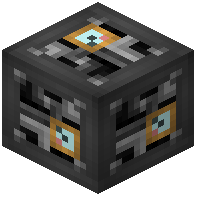 Heavy Engineering Block.
 - If the bucket wheel is positioned correctly, forming the engine will also form the wheel along with it.
- To assemble the complete structure at once, use the Engineer's Hammer on the rear central Heavy Engineering Block.
Like other multiblock constructions in the mod, the Excavator is built from its constituent parts and then assembled rather than crafted whole on a bench.
Finding and Reading Mineral Deposits
Small, concentrated deposits of ore are visible to the naked eye and can be recovered with hand tools. The deeper, sparse mineral veins are a different problem. Because veins are part of the stone itself, Survey Tools are needed to locate traces of them.
Use survey tools on blocks of natural rock and soil to identify approximate vein locations. Every sample taken from the same vein sharpens the estimate of its center and contents. Veins can overlap, so a survey may reveal traces of several veins close together. Sample sites placed too close to one another do not yield useful information. Artificial blocks, plants, and fluids contain no vein traces and cannot be surveyed.
Core Sample Drills and Saturation
A Core Sample Drill gives precise identification of a vein's composition and expected yield. It cannot be run on air or water. The drill can be started by hand and stopped with a redstone signal. When supplied with power, it consumes Flux/t to produce a core sample.
Core samples are delicate and must be removed manually, in much the same way the machine is activated again. They can be read visually to judge the relative presence of minerals, and unlike simple surveying, a core sample reveals Saturation. Higher saturation means a greater chance for an Excavator to return an ore. Samples can be placed while sneaking for easy reference, and right-clicking a placed sample can mark the vein on a map with a red triangle. Core samples show mineral wealth only, not aquifers or other fluid traces.
Siting Matters
Even a high-saturation vein cannot be worked without bringing up the surrounding stone. When a deposit is worked from far away, more of the ore ends up lost in the spoil rock and dirt. That inefficiency means a poorly sited Excavator produces less ore than one placed well. Survey first, drill for saturation, then build.
Covers the mod’s in-game guide topics: Excavator Mineral Deposits Ores Large Constructions